In the last post, we looked at an iterative online update to a logistic regression model. This derivation requires knowledge of the derivative with respect to the model’s weights, which is intractible for more complicated models. In practice, one wants to use neural networks for prediction tasks...
For non-stationary distributions, it may be beneficial to learn (at least some) parameters for your models online. A common approach is to learn a logistic regression model for binary outcomes, and this technique appears as early as 2008 at Yahoo! News. There are several approaches to deriving the...
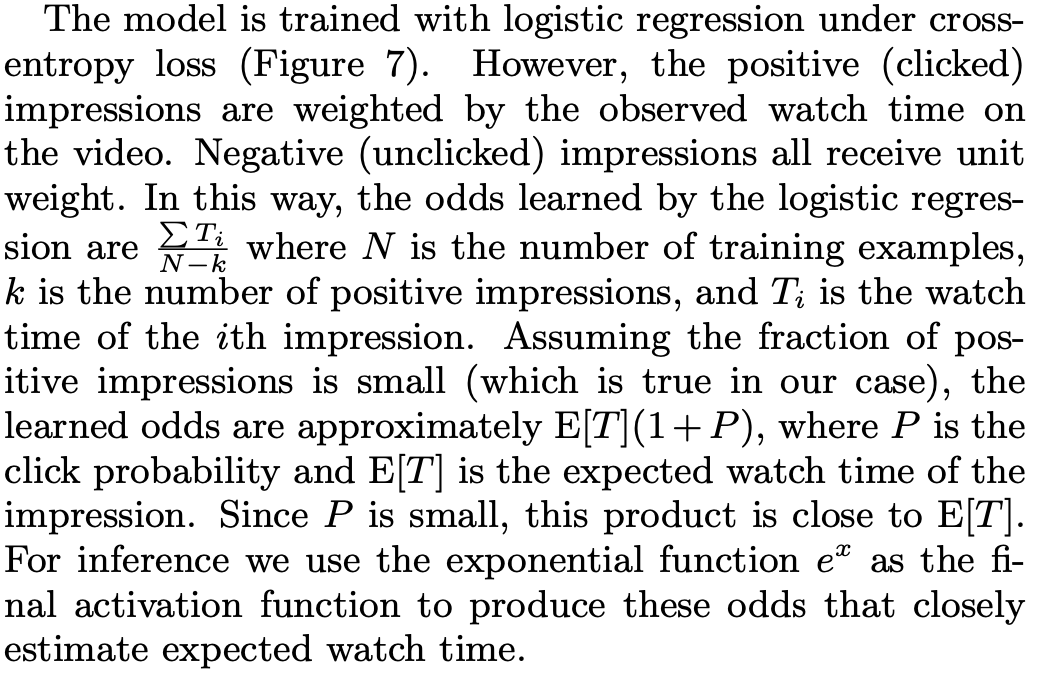
In reading the YouTube Paper, I came across one technical section that seemed very subtle and was not readily apparent why it was true: the watch time estimation using weighted logistic regression. It’s easy to gloss over this detail, but as it turns out, many people before me were curious about...
In this post, we explore two approaches for training a linear regression online and compare their behavior on non-stationary data. We begin by deriving online linear regression and the Kalman filter update from first principles. Then, we empirically show differences between the two methods by...
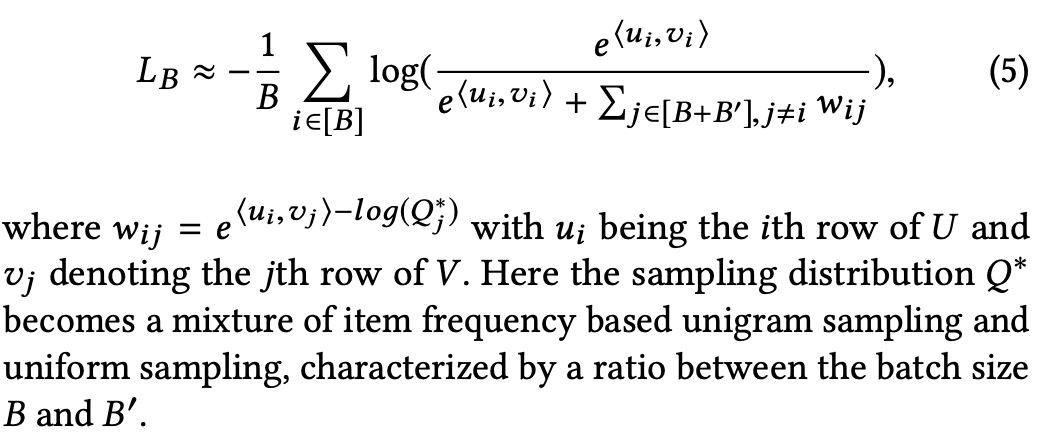
In our previous posts, we walked through the sampled softmax and in-batch negatives as loss functions for training a retrieval model. In this post, we will explore the best of both worlds in the so-called mixed negative sampling. This method will prove the to be the most data efficient and yield...
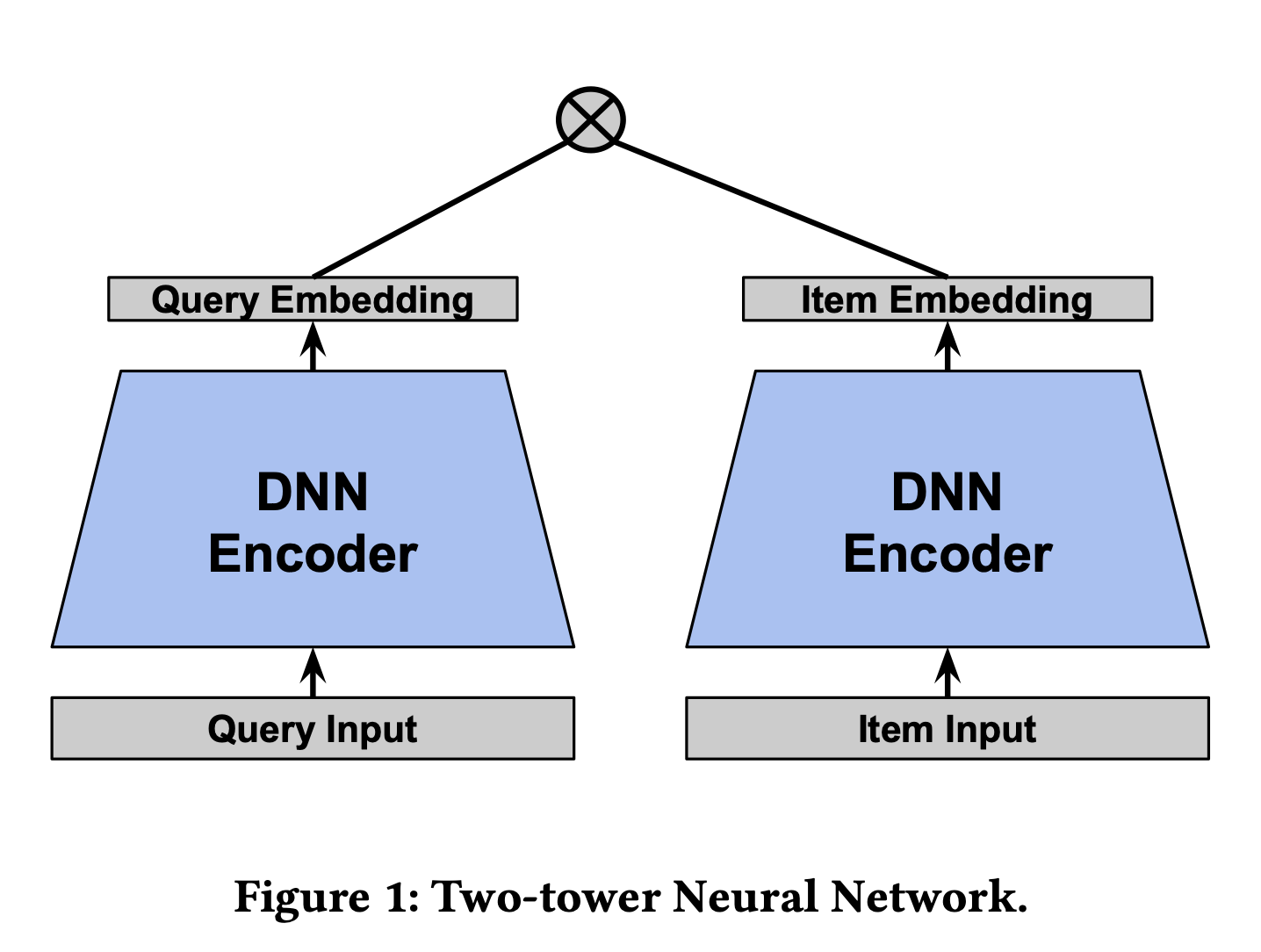
Consider the retrieval problem in a recommendation system. One way to model the problem is to create a big classification model predicting the next item a user will click or watch. This basic approach could be extended to large catalogs via a sampled softmax loss, as discussed in our last post....
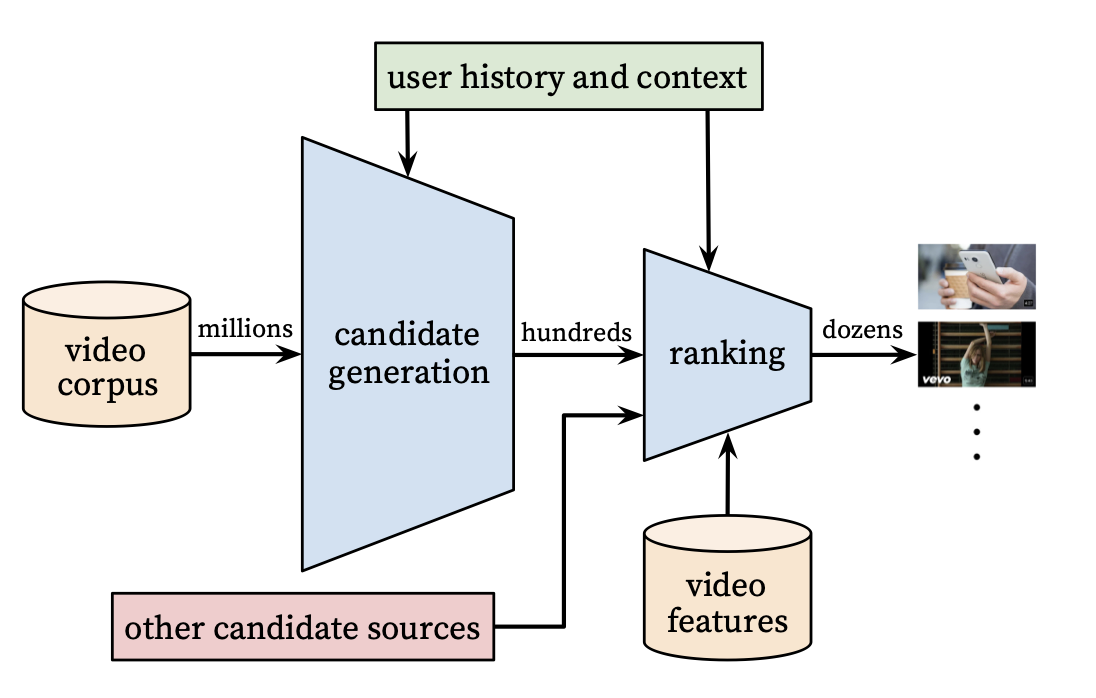
Sometimes I’m asked how to start learning about recommender systems, and there’s a few go-to papers I always mention; however, without a proper map, it could be alittle difficult for the uninitiated. So, to try to make a gentle introduction, I will walk through an implementation of the candidate...
In this post, we explore a situation typical of a website, where a user is allowed to view the page multiple times and may click on a button of interest on any visit. We would like to perform an A/B test on the non-user level metric, the click-through rate (CTR), defined via total clicks divided...
In the original CUPED paper, the authors mention that it is straightforward to generalize the method to multiple covariates. However, without understanding exactly the mathematical technique to find the CUPED estimate, it may be confusing to attempt the multiple covariates case. In this post, we...
In the past decade, there have been many advancements to enable A/B testing at (sometimes even small!) scale. Thankfully, many A/B testing practitioners have come forward and written books and papers on the finer details. Even with the deluge blog posts on the subject– there’s one topic that does...