There’s a popular podcast produced by the New York Times: Hard Fork. It talks about technology, and since a lot of people these days find it difficult to talk about technology without mentioning “AI”, the two Hard Fork hosts make two disclaimers in almost every episode: That the New York Times is...
It sometimes happens in people’s lives that someone tells them something that sounds true and obvious at the time. It turns out that it actually is objectively true, and it is also obvious, or at least sensible, to the person who hears it, but it’s not obvious to other people. But it was obvious...
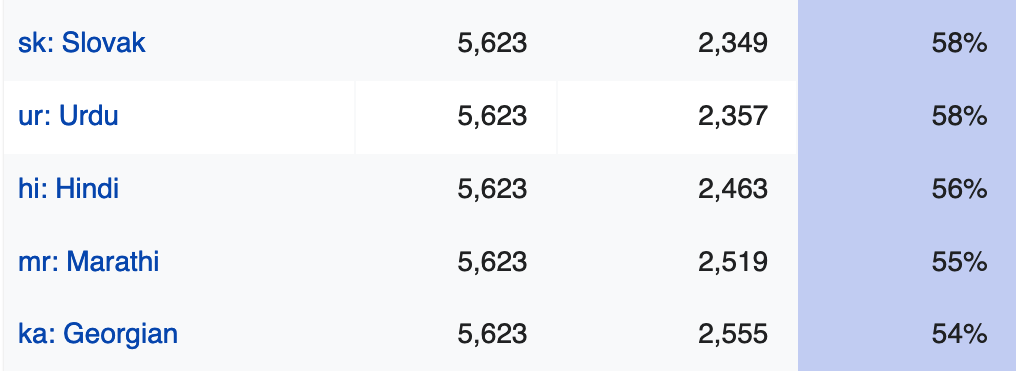
I was wondering: In which languages, user interface translations tend to be longer, and in which ones they are shorter? The intuitive answers to these questions are that Chinese and Japanese are very short, English tends to be shorter than the average, Hebrew is shorter than English, and the...
This is a new version of a post that was originally published in 2015. Much of it is the same, but there are several updates that justified publishing a new version. Introduction As you probably already know, Wikipedia is a website. A website has two components: the content and the user...
This post is outdated. For a newer version see Amir Aharoni’s Quasi-Pro Tips for Translating the Software That Powers Wikipedia, 2020 Edition Español: Iniciando la Traducción y la Localización de la Interfaz de WikipediaFrançais: Débuter dans la traduction et la localisation de l’interface...
In November I gave a talk about how we do localization in Wikimedia at a localization meetup in Tel-Aviv, kindly organized by Eyal Mrejen from Wix. I presented translatewiki.net and UniversalLanguageSelector. I quickly and quite casually said that when you submit a translation at translatewiki,...