The concept for this post began in 2022, and as so often happens, I got distracted by some other rabbit hole and came across its draft while looking for another previous post. In November 2025, a similar approach was used to produce modified hexagons to achieve automated star shapes. The basic...
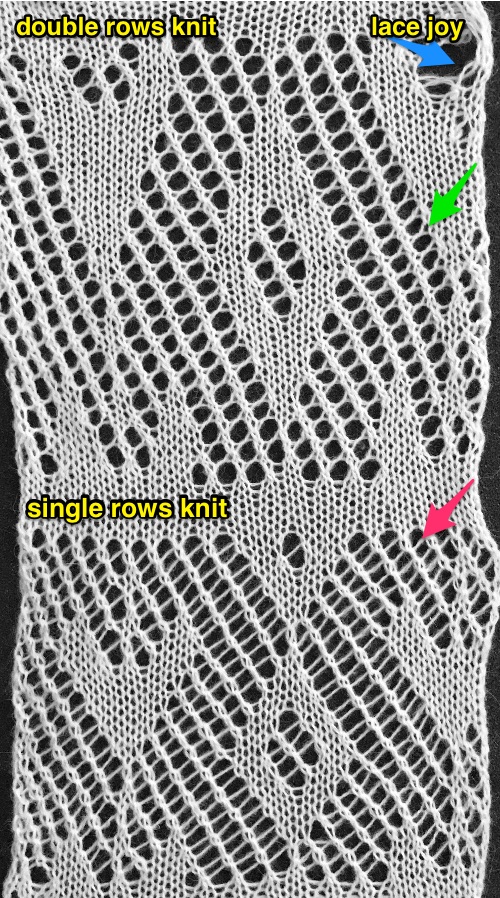
Ways to modify electronic and punch card published transfer lace designs looked at some ways to achieve lace designs on Brother models with single knit rows between transfer segments, which influences the number of total knit and lace carriage passes, changes the appearance of the spaces between...
IN PROGRESS Revisiting “wisteria” 3D shapes and their possible automation, reviewed a collection of blog posts, including repeat options that formed open, highly textured knits, with ladders, eyelets, and sometimes added patterning. This repeat forms a more compact, textured surface with none of...
Recently, in the Machine Knitting Facebook Group, a post by Jeannette/eKnitter describing her method with an associated YouTube video on Transforming a Brother Stitch World Lace Pattern sent me down a new-to-me, what-happens-if-rabbit hole. Results for any lace designs vary considerably based on...
Whatever the goal in DIY, when automating designs, black pixels or punched holes are selected and knit, while white pixels or unpunched holes are not selected, and used to produce textured, color-patterned knits, or serve as guides to added actions when combined with the knit carriage cam...
IN PROGRESS Single bed slip stitch vs ruching included a highly textured sample with a 64X96 repeat that could serve as the start of subsequent explorations. The plan was to introduce FI or FI-like patterning to the fold areas of the design. However, those areas must be knit in slip stitch as...
Present software makes it easy to explore designs, in color or BW, meeting download or punching requirements, before any actual knitting takes place. The digital explorations, and printing them tiled in a larger format than on our screens, can help to visualize whether the results, when tiled in...
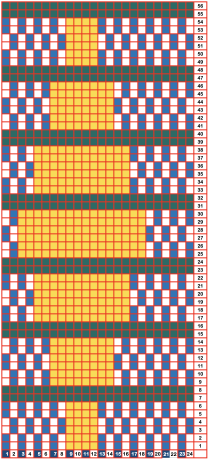
The spreadsheet plan, 24X56 cells, with colors edited to yield a brick repeat suitable for tuck stitch, 24X112test knit on 48 stitches using a 2/8 wool. Adjustments were made in the spreadsheet to increase the tuck texture while blunting the diamond shape, configured for a brick repeat, 24X120....