In the two previous posts, we learned about chain complexes and their homology groups. We are now ready for another foundational concept needed to understand QEC from a topological perspective: in this copost, we will dive into cohomology! When learning about the surface code, we saw that \(Z\)...
In the previous post, we introduced algebraic topology through one of its most important objects: chain complexes. We saw how chain complexes can be constructed from cellulations of manifolds and how they give rise to CSS codes. But the main reason both mathematicians and quantum error correctors...
To continue our journey into quantum error correction, it is time to dive deeper into the theoretical foundations of the field. When learning about the surface code, you might have wondered: what exactly makes it work? Would it work as well on lattices other than the square lattice? On manifolds...
If you have been following the quantum news lately, you certainly didn’t miss one of the biggest announcements of the year: the demonstration of various quantum codes and logical operations on up to 48 logical qubits and 280 physical qubits of a Rydberg atom array. To me, one of the most exciting...
Welcome to the third and last post of the stabilizer trilogy! In Parts I and II, we introduced the stabilizer formalism using a group theoretic language: stabilizer codes are abelian subgroups of the Pauli group, logicals are elements of the centralizers, etc. While this formulation has a lot of...
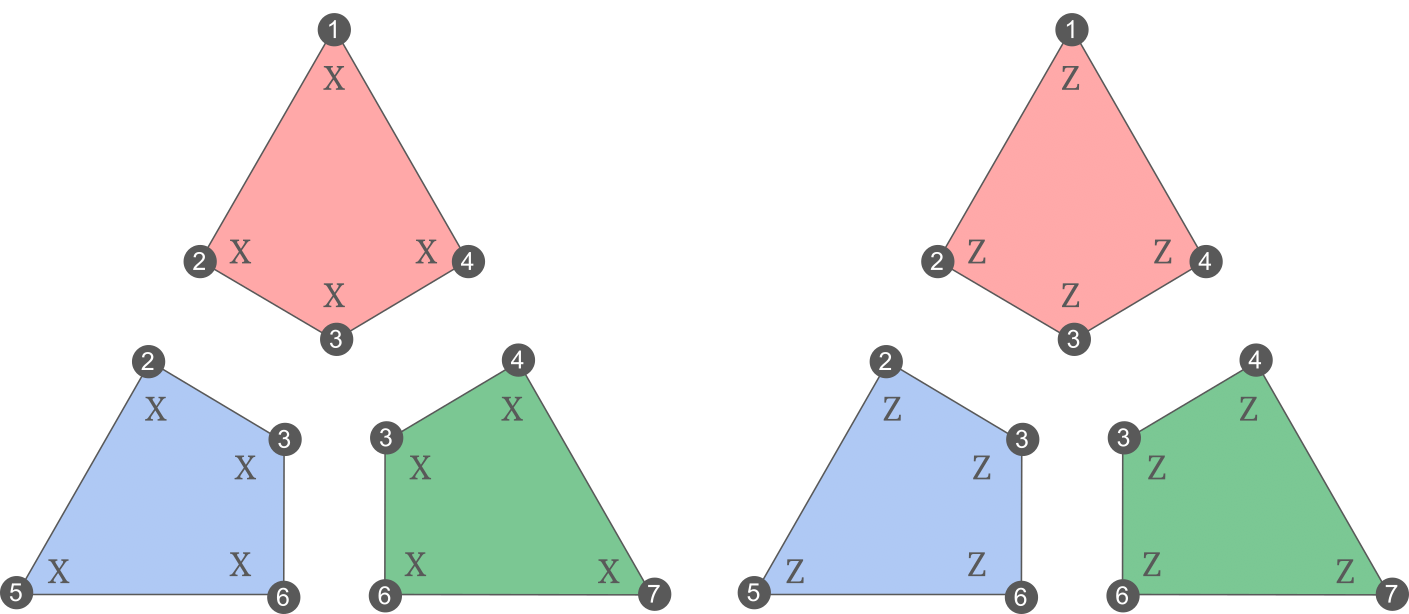
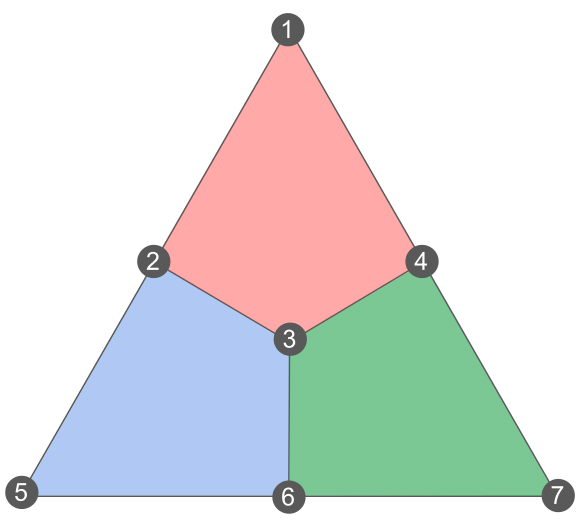
Happy to see you back for the second part of the stabilizer trilogy! In the previous post, we defined stabilizer codes and gave a few examples of codes and constructions. In particular, we studied the Steane code, which can be defined by laying down seven qubits on a triangle with three colored...
Now that you know all you need to know about classical error correction, the time has finally come to learn how to correct those damn errors that keep sabotaging your quantum computer! The key tool, introduced by Daniel Gottesman in his landmark 1997 PhD thesis is the stabilizer formalism. The...
When learning about quantum error correction (QEC) for the first time, I tried to jump directly into the core of the subject, going from the stabilizer formalism to topological codes and decoders, but completely missing the classical origin of those notions. The reason is that many introductions...
This Summer marked the beginning of my thesis work, and with it, of my trip in the fascinating world of quantum error correction. I quickly found in this area the interdisciplinarity that I love: the field takes its roots in theoretical computer science (classical error correction), uses...