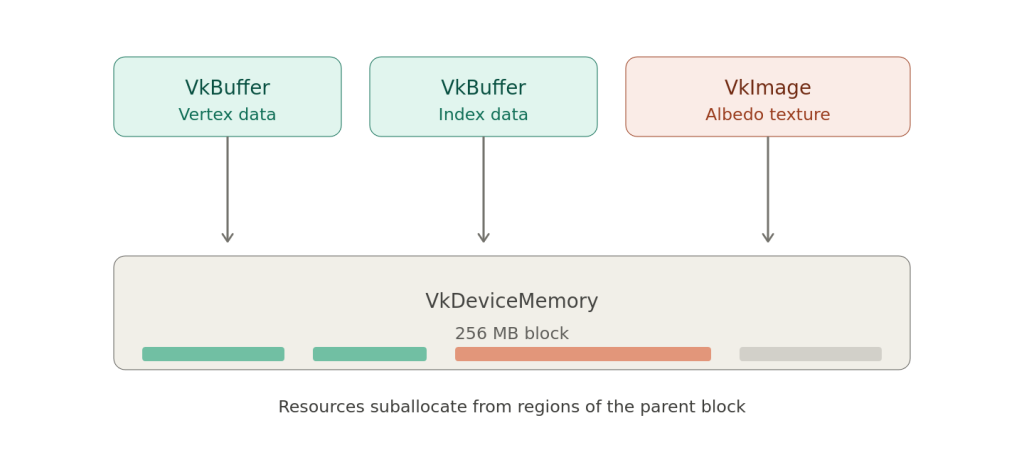
AnKi’s GPU memory management system was introduced alongside Vulkan nine years ago, but the transition to GPU-driven rendering and the introduction of a render-graph fundamentally changed the way GPU memory is handled. In this blog post we will look at how the system evolved over the years and as...
AnKi has had ray-tracing support for quite some time. Beyond managing acceleration structures, the engine uses VK_KHR_ray_tracing_pipeline/DXR 1.0 for shadows (soon deprecated), indirect diffuse, and indirect specular. Upon initialization, the engine reads pre-compiled shader binary blobs and...
This time I decided to would try something different and do a video presentation instead of a blog post. There were a lot of things to cover and a video presentation seemed better. Anyway, here is the video: And here the link the the presentation:...
TL;DR: If using per-primitive in/out in mesh shaders in Vulkan and in HLSL/DXC you need to manually decorate variables and struct members using SPIR-V intrinsics. See how at the bottom. This is going to be a quick post to raise awareness to a difficult to track bug with mesh shaders in Vulkan...
SPIR-V is a binary language that describes the GPU shader code for the Vulkan and OpenCL APIs. For most graphics programmers SPIR-V is a completely opaque binary blob that they don’t have to touch or know much about. Someone can use their preferred compiler to translate GLSL or HLSL to SPIR-V, can...
For the last few months AnKi underwent a heavy re-write in order to enable GPU driven rendering. This post will quickly go through the changes and the design without diving too deep into details. There will be another post (or maybe video) with all the implementation details. What is GPU...
AnKi always had its shaders written in GLSL because it started as an OpenGL engine. Recently I decided to start rewriting them from GLSL to HLSL with one of the main motivations being that GLSL, as a language, has stopped evolving and it’s missing modern features. Sure, there are new extensions...
I think it was 8 or 9 years ago when AnKi was first ported to Android for a demo competition and I remember the process being quite painful. Building native projects for Android was a hack, the micro differences between OpenGL ES and desktop OpenGL required compromises, GLSL related issues were a...
I've been working on kopper recently, which is a complementary project to zink. Just as zink implements OpenGL in terms of Vulkan, kopper seeks to implement the GL window system bindings - like EGL and GLX - in terms of the Vulkan WSI extensions. There are several benefits to doing this, which...
Some days ago I was trying to use the debugPrintf functionality that was introduced to Vulkan and adjacent projects more than a year ago. Since I haven’t found (or maybe I missed it) a good online document that describes all the steps to enable such functionality programmatically, I thought it...
In an ideal world, every frame your application draws would appear on the screen exactly on time. Sadly, as anyone living in the year 2020 CE can attest, this is far from an ideal world. Sometimes the scene gets more complicated and takes longer to draw than you estimated, and sometimes the OS...