Young tableaux are to planes as labeled trees are to curves. Continuing from the previous post in this series, we introduce the Chow ring of $\overline{M}_{0,n}$ and some important classes. Recall that in the first post, we answered the question “How many cubic curves in $\mathbb{P}^3$ pass...
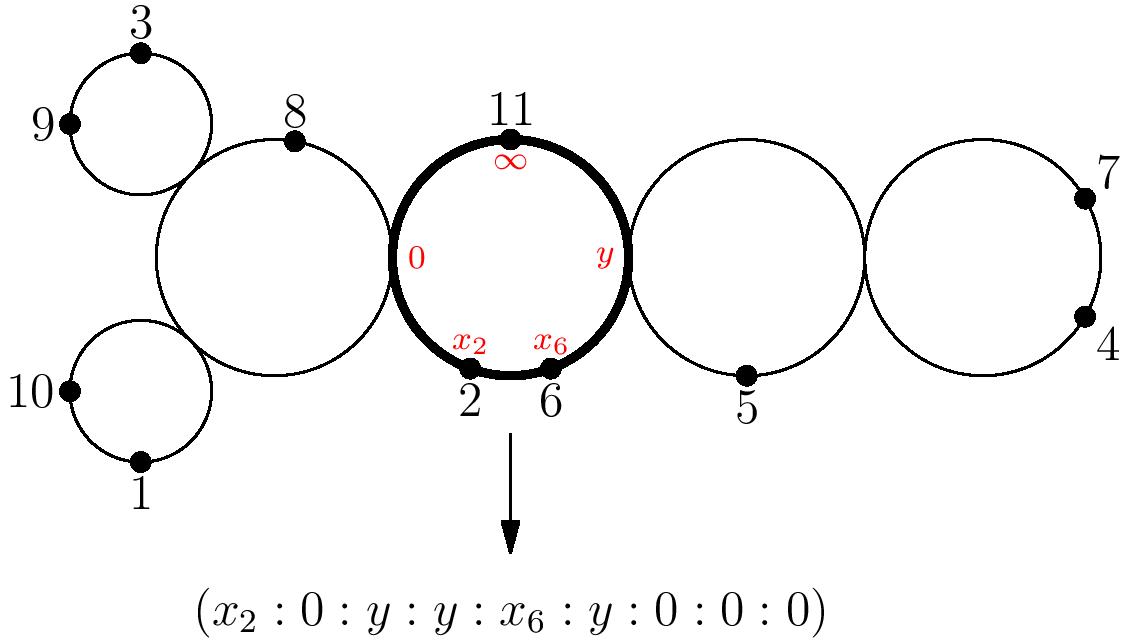
Young tableaux are to planes as labeled trees are to curves. Continuing from the previous post in this series, we now show how to think of $\overline{M}_{0,n}$ as a projective variety. We now show how to look from the perspective of a single point, and combine this with the forgetting maps, to...
Young tableaux are to planes as labeled trees are to curves. Continuing from the motivation of the previous post, we now dive into the structure of the moduli space $\overline{M}_{0,n}$, and construct two recursive structures that lead to beautiful inductive theory, and, in the next post, the...
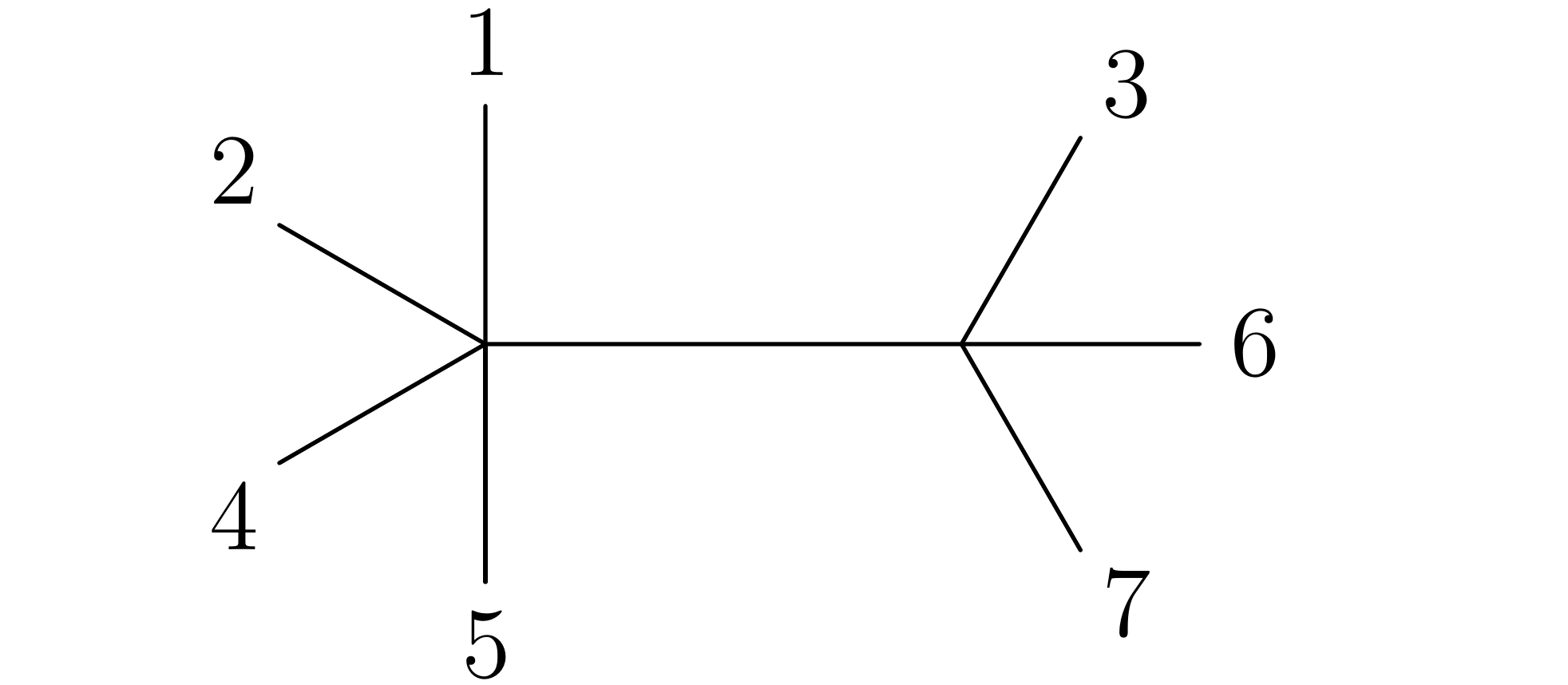
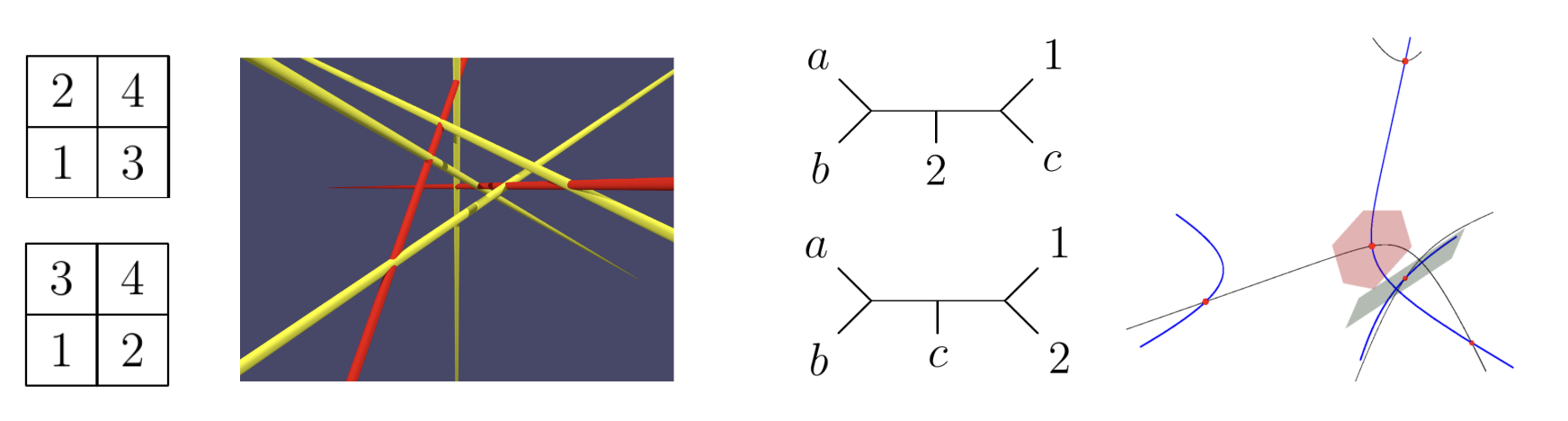
Young tableaux are to planes as labeled trees are to curves. This is the analogy from which I hope to start a series of posts on the beauty of the growing field of connections between the geometry of moduli spaces of curves, and combinatorics. What do the pictures above have in common? Two...
In this arXiv paper, Hikita recently posted a proof of the famous Stanley-Stembridge conjecture! I went through the proof with my Advanced Combinatorics class, and wrote up lecture notes here: Lecture Notes on Stanley-Stembridge Part I Lecture Notes on Stanley-Stembridge Part II which I will...
Rubik's cube (Wikipedia)Preamble Counting is one of the most important concepts in probability and statistical mechanics as well. Two primary characteristics of choosing $n$ items from $N$ items are (no)-order and (no)-repeat. This leads to four possible cases that leads to combinations and...