Young tableaux are to planes as labeled trees are to curves. Continuing from the previous post in this series, we introduce the Chow ring of $\overline{M}_{0,n}$ and some important classes. Recall that in the first post, we answered the question “How many cubic curves in $\mathbb{P}^3$ pass...
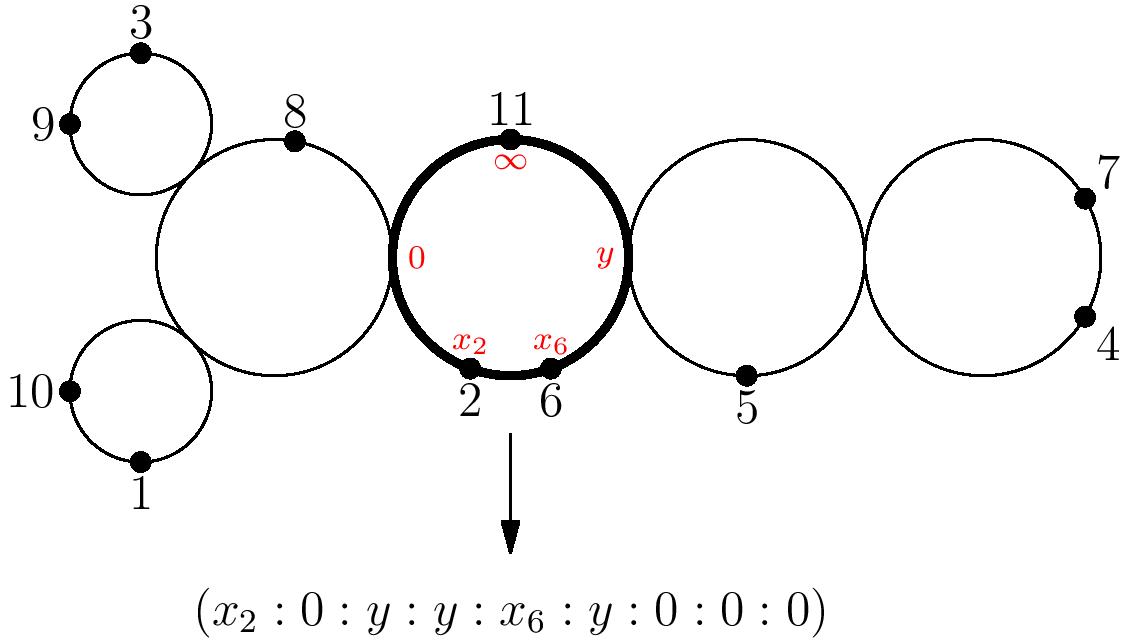
Young tableaux are to planes as labeled trees are to curves. Continuing from the previous post in this series, we now show how to think of $\overline{M}_{0,n}$ as a projective variety. We now show how to look from the perspective of a single point, and combine this with the forgetting maps, to...
Young tableaux are to planes as labeled trees are to curves. Continuing from the motivation of the previous post, we now dive into the structure of the moduli space $\overline{M}_{0,n}$, and construct two recursive structures that lead to beautiful inductive theory, and, in the next post, the...
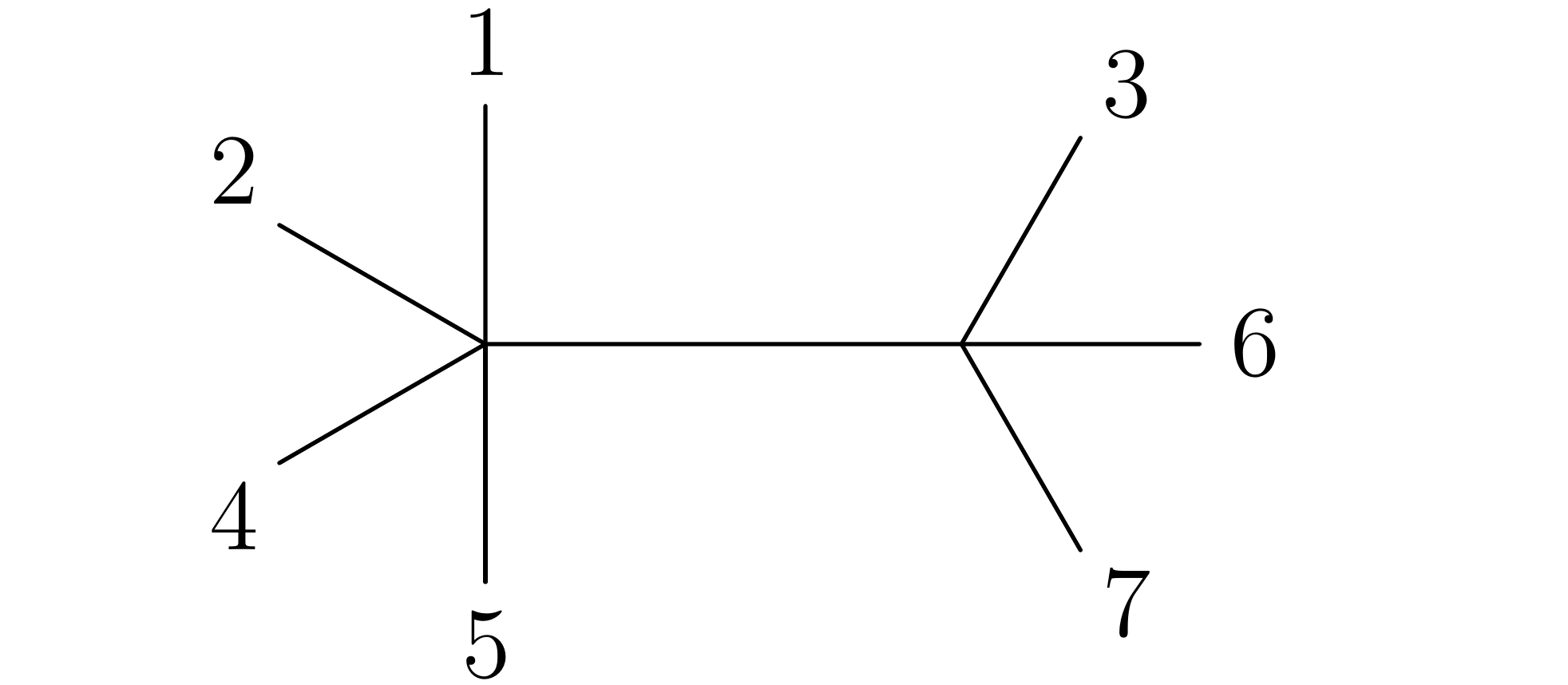
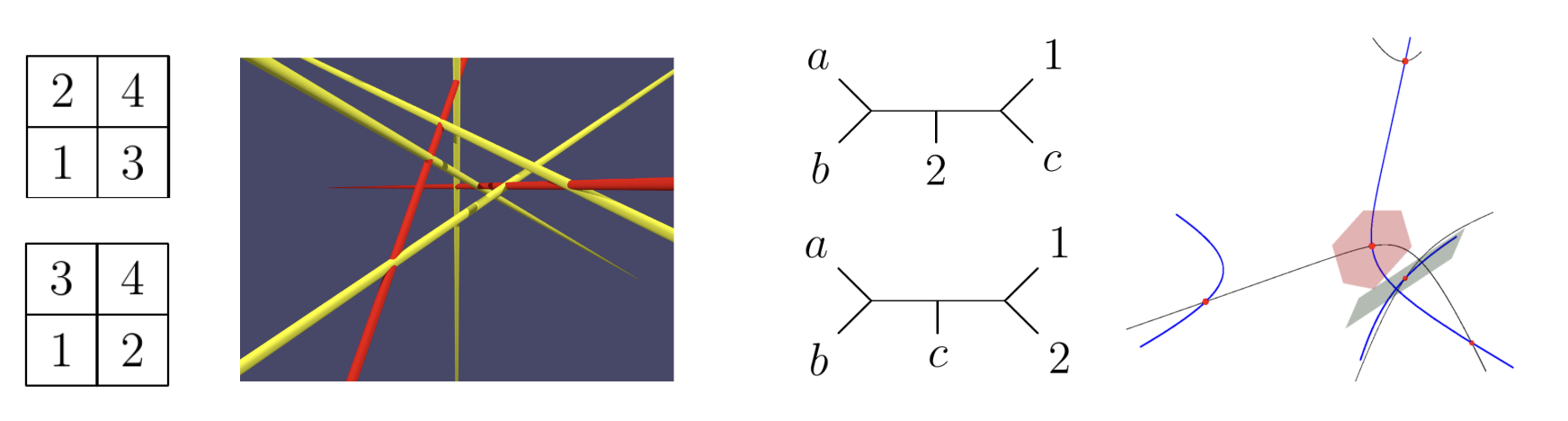
Young tableaux are to planes as labeled trees are to curves. This is the analogy from which I hope to start a series of posts on the beauty of the growing field of connections between the geometry of moduli spaces of curves, and combinatorics. What do the pictures above have in common? Two...
The CSU math graduate students have started writing a really fun monthly math magazine for the department, featuring stories, mathematical tidbits, and puzzles collected from the department and slid under all the professors’ doors each month. It’s been a joy to read, and every month they have a...
I haven’t posted in a while; it’s time to dust off this blog and get things started again with a guest post! In this post, guest user Anon1 posted a proof of the existence of finite fields of every possible order. Today I’ll share a writeup by the same user on the Schur-Zassenhaus Theorem in...
In this arXiv paper, Hikita recently posted a proof of the famous Stanley-Stembridge conjecture! I went through the proof with my Advanced Combinatorics class, and wrote up lecture notes here: Lecture Notes on Stanley-Stembridge Part I Lecture Notes on Stanley-Stembridge Part II which I will...
I have written about the flag variety, the Springer resolution, and the relation between the type A Springer correspondence and Hall-Littlewood polynomials in a previous sequence of posts. Time to extend this construction to the (type A) affine flag variety, corresponding to affine Lie type...
After a bit of a hiatus due to difficulties with Wordpress, Mathematical Gemstones is back! Feel free to browse the new layout. Today’s post introduces moduli spaces of curves, and one of the many ways combinatorial gemstones arise in this vast area of algebraic geometry. A brief motivating...
Time for a just-for-fun combinatorial problem! Thanks to my brother Kenneth Monks for suggesting it. Consider the numbers of the form $2^{2^n}-1$ for positive integers $n$. The first few, for $n=1,2,3,4,\ldots$, are: \[3, 15, 255, 65535, \ldots\] One thing that all of these numbers have in...