My previous blog post reviewed the concept of the Hausdorff distance (which more descriptively could be called farthest distance.) Despite its usefulness in matching geometric data, there are surprisingly few open-source implementations, and seemingly no efficient ones for linear and polygonal...
The Hausdorff Distance is a useful spatial function which can appear slightly mysterious. Partly this is due to the name. It honours Felix Hausdorff, one of the founding fathers of topology, and a polymath who was creative in music and literature as well as mathematics. Felix Hausdorff ...
Some spatial use cases require identifying "narrow" or "skinny" polygons. A classic example is the process of cleaning polygonal coverages. Coverages (even clean ones) may contain narrow gaps between polygons which are unwanted. But they may also contain larger gaps which are valid. A geometric...
A previous post introduced a new algorithm in the JTS Topology Suite called RelateNG. It computes topological relationships between geometries using the Dimensionally-Extended 9 Intersection Model (DE-9IM) model. This algorithm is fundamental to a large proportion of spatial queries executed in...
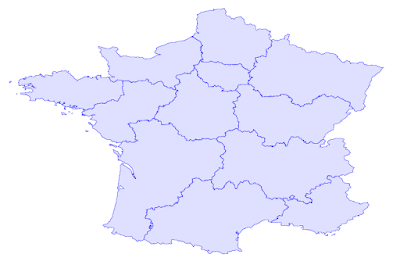
A new capability for the JTS Topology Suite is operations to process Simple Polygonal Coverages. A Simple Polygon Coverage is a set of edge-matched, non-overlapping polygonal geometries (which may be non-contiguous, and have holes). Typically this is used to model an area in which every point...
The next operation delivered in the build-out of Simple Polygonal Coverages in the JTS Topology Suite is Coverage Union. This is simply the topological union of a set of polygons in a polygonal coverage, producing one or more polygons as the result. (This is sometimes called "dissolve" in the...
Recently JTS gained the ability to compute Concave Hulls of point sets. The algorithm used is based the Chi-shapes approach described by Duckham et al. It works by eroding border triangles from the Delaunay Triangulation of the input points, in order of longest triangle edge length, down to a...
The previous post discussed polygonal coverages and outlined the plan to support them in the JTS Topology Suite. This post presents the first step of the plan: algorithms to validate polygonal coverages. This capability is essential, since coverage algorithms rely on valid input to provide...
JTS 1.19 has just been released! There is a great deal of new, improved and fixed functionality in this release - see the GitHub release page or the Version History for full details.This blog has several posts describing new functionality in JTS 1.19:New FunctionalityConcave Hull of...
The previous post introduced the new ConcaveHullOfPolygons class in the JTS Topology Suite. This allows computing a concave hull which is constrained by a set of polygonal geometries. This supports use cases including:generalization of groups of polygonjoining polygonsfilling gaps between...
A common spatial need is to compute a polygon which contains another set of polygons. There are numerous use cases for this; for example:Generalizing groups of building outlines (questions: 1, 2) Creating "district" polygons around block polygons (questions: 1)Removing gaps between sets of...
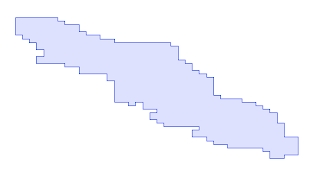
The electrons were hardly dry on the JTS Outer and Inner Polygon Hull post when another interesting use case popped up on GIS StackExchange. The question was how to remove aliasing artifacts (AKA "jaggies") from polygons created by vectorizing raster data, with the condition that the result...
The JTS Topology Suite recently gained the ability to compute concave hulls. The Concave Hull algorithm computes a polygon enclosing a set of points using a parameter to determine the "tightness". However, for polygonal inputs the computed concave hull is built only using the polygon vertices,...
Offset curves (also known as parallel curves) are an oft-requested feature in JTS. They are a natural extension to the concept of buffering, and are useful for things like placing labels along rivers. As far as I know there is no hard-and-fast definition for how an offset curve should be...
In a previous post I described how the JTS Topology Suite operation IsSimpleOp has been completely rewritten to reduce code dependencies, improve performance, and provide a simpler, more understandable implementation. The post points out that the IsValidOp implementation would benefit from the...