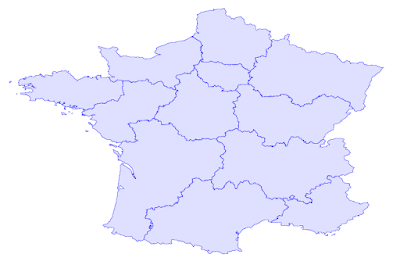
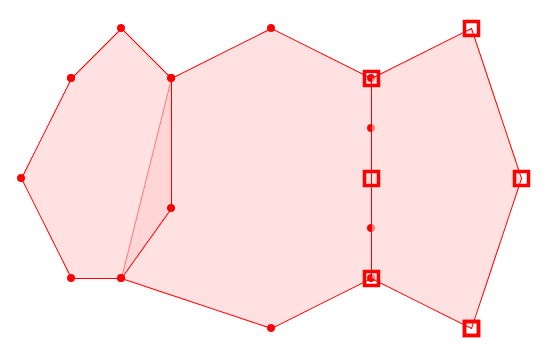
Some spatial use cases require identifying "narrow" or "skinny" polygons. A classic example is the process of cleaning polygonal coverages. Coverages (even clean ones) may contain narrow gaps between polygons which are unwanted. But they may also contain larger gaps which are valid. A geometric...
The JTS Topology Suite has been rolling out the capability to manage polygonal coverages. It supports modelling polygonal coverages as arrays of discrete polygonal geometries. This is simple to work with and allows using all of the wide variety of JTS algorithms. Coverage topology allows...
A previous post introduced a new algorithm in the JTS Topology Suite called RelateNG. It computes topological relationships between geometries using the Dimensionally-Extended 9 Intersection Model (DE-9IM) model. This algorithm is fundamental to a large proportion of spatial queries executed in...
The most fundamental and widely-used operations in the JTS Topology Suite are the ones that evaluate topological relationships between geometries. JTS implements the Dimensionally-Extended 9 Intersection Model (DE-9IM), as defined in the OGC Simple Features specification, in the RelateOp...
A new capability for the JTS Topology Suite is operations to process Simple Polygonal Coverages. A Simple Polygon Coverage is a set of edge-matched, non-overlapping polygonal geometries (which may be non-contiguous, and have holes). Typically this is used to model an area in which every point...
The next operation delivered in the build-out of Simple Polygonal Coverages in the JTS Topology Suite is Coverage Union. This is simply the topological union of a set of polygons in a polygonal coverage, producing one or more polygons as the result. (This is sometimes called "dissolve" in the...
There is an elegant mathematical theory of binary relations. Homogeneous relations are an important subclass of binary relations in which both domains are the same. A homogeneous relation R is a subset of all ordered pairs (x,y) with x and y elements of the domain. This can be thought of as a...
The previous post discussed polygonal coverages and outlined the plan to support them in the JTS Topology Suite. This post presents the first step of the plan: algorithms to validate polygonal coverages. This capability is essential, since coverage algorithms rely on valid input to provide...
The previous post introduced the new ConcaveHullOfPolygons class in the JTS Topology Suite. This allows computing a concave hull which is constrained by a set of polygonal geometries. This supports use cases including:generalization of groups of polygonjoining polygonsfilling gaps between...
A common spatial need is to find a polygon that accurately represents a set of points. The convex hull of the points often does not provide this, since it can enclose large areas which contain no points. What is required is a non-convex hull, often termed the concave hull. The Convex Hull and a...
Offset curves (also known as parallel curves) are an oft-requested feature in JTS. They are a natural extension to the concept of buffering, and are useful for things like placing labels along rivers. As far as I know there is no hard-and-fast definition for how an offset curve should be...
Recently a GEOS patch was contributed to change the KdTree query implementation to use an explicit stack rather than recursion. This has been ported to JTS as PR #779 (along with some refactoring).The change was motivated by a QGIS issue in which a union of some large polygons caused a stack...