My previous blog post reviewed the concept of the Hausdorff distance (which more descriptively could be called farthest distance.) Despite its usefulness in matching geometric data, there are surprisingly few open-source implementations, and seemingly no efficient ones for linear and polygonal...
The Hausdorff Distance is a useful spatial function which can appear slightly mysterious. Partly this is due to the name. It honours Felix Hausdorff, one of the founding fathers of topology, and a polymath who was creative in music and literature as well as mathematics. Felix Hausdorff ...
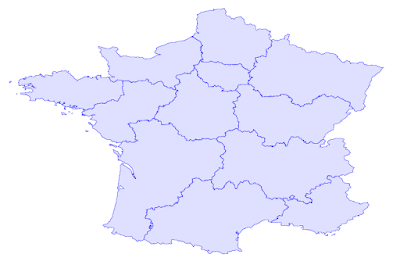
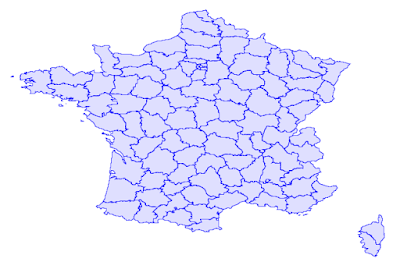
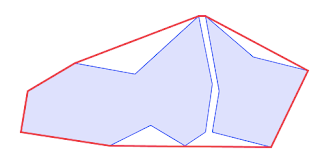
Some spatial use cases require identifying "narrow" or "skinny" polygons. A classic example is the process of cleaning polygonal coverages. Coverages (even clean ones) may contain narrow gaps between polygons which are unwanted. But they may also contain larger gaps which are valid. A geometric...
The JTS Topology Suite has been rolling out the capability to manage polygonal coverages. It supports modelling polygonal coverages as arrays of discrete polygonal geometries. This is simple to work with and allows using all of the wide variety of JTS algorithms. Coverage topology allows...
A previous post introduced a new algorithm in the JTS Topology Suite called RelateNG. It computes topological relationships between geometries using the Dimensionally-Extended 9 Intersection Model (DE-9IM) model. This algorithm is fundamental to a large proportion of spatial queries executed in...
The most fundamental and widely-used operations in the JTS Topology Suite are the ones that evaluate topological relationships between geometries. JTS implements the Dimensionally-Extended 9 Intersection Model (DE-9IM), as defined in the OGC Simple Features specification, in the RelateOp...
A new capability for the JTS Topology Suite is operations to process Simple Polygonal Coverages. A Simple Polygon Coverage is a set of edge-matched, non-overlapping polygonal geometries (which may be non-contiguous, and have holes). Typically this is used to model an area in which every point...
The next operation delivered in the build-out of Simple Polygonal Coverages in the JTS Topology Suite is Coverage Union. This is simply the topological union of a set of polygons in a polygonal coverage, producing one or more polygons as the result. (This is sometimes called "dissolve" in the...
Recently JTS gained the ability to compute Concave Hulls of point sets. The algorithm used is based the Chi-shapes approach described by Duckham et al. It works by eroding border triangles from the Delaunay Triangulation of the input points, in order of longest triangle edge length, down to a...
There is an elegant mathematical theory of binary relations. Homogeneous relations are an important subclass of binary relations in which both domains are the same. A homogeneous relation R is a subset of all ordered pairs (x,y) with x and y elements of the domain. This can be thought of as a...
The previous post discussed polygonal coverages and outlined the plan to support them in the JTS Topology Suite. This post presents the first step of the plan: algorithms to validate polygonal coverages. This capability is essential, since coverage algorithms rely on valid input to provide...
An important concept in spatial data modelling is that of a coverage. A coverage models a two-dimensional region in which every point has a value out of a range (which may be defined over one or a set of attributes). Coverages can be represented in both of the main physical spatial data models:...
JTS 1.19 has just been released! There is a great deal of new, improved and fixed functionality in this release - see the GitHub release page or the Version History for full details.This blog has several posts describing new functionality in JTS 1.19:New FunctionalityConcave Hull of...
The previous post introduced the new ConcaveHullOfPolygons class in the JTS Topology Suite. This allows computing a concave hull which is constrained by a set of polygonal geometries. This supports use cases including:generalization of groups of polygonjoining polygonsfilling gaps between...
A common spatial need is to compute a polygon which contains another set of polygons. There are numerous use cases for this; for example:Generalizing groups of building outlines (questions: 1, 2) Creating "district" polygons around block polygons (questions: 1)Removing gaps between sets of...
The electrons were hardly dry on the JTS Outer and Inner Polygon Hull post when another interesting use case popped up on GIS StackExchange. The question was how to remove aliasing artifacts (AKA "jaggies") from polygons created by vectorizing raster data, with the condition that the result...
The JTS Topology Suite recently gained the ability to compute concave hulls. The Concave Hull algorithm computes a polygon enclosing a set of points using a parameter to determine the "tightness". However, for polygonal inputs the computed concave hull is built only using the polygon vertices,...
As the title of this blog indicates, I'm a fan of linearity. But sometimes a little non-linearity makes things more interesting. A convenient way to generate non-linear curved lines is to use Bezier Curves. Bezier Curves are curves defined by polynomials. Bezier curves can be defined for...
A common spatial need is to find a polygon that accurately represents a set of points. The convex hull of the points often does not provide this, since it can enclose large areas which contain no points. What is required is a non-convex hull, often termed the concave hull. The Convex Hull and a...
Offset curves (also known as parallel curves) are an oft-requested feature in JTS. They are a natural extension to the concept of buffering, and are useful for things like placing labels along rivers. As far as I know there is no hard-and-fast definition for how an offset curve should be...
Every so often I produce an image in the JTS TestBuilder which strikes me as worthy of capture. Here's one that seems pretty seasonal:It is generated like this:Produce two sets of 1000 random points roughly aligned with a gridCompute their fully-eroded Convex HullsCompute the intersection of the...
A (long) while ago I posted about "soon-to-be-released" JTS code for polygon triangulation using Ear Clipping. It turned out it was actually in the category of "never-to-be-released". However, later I worked with a student, Dan Tong, on a coding exercise sponsored by Facebook. We decided to...
Recently a GEOS patch was contributed to change the KdTree query implementation to use an explicit stack rather than recursion. This has been ported to JTS as PR #779 (along with some refactoring).The change was motivated by a QGIS issue in which a union of some large polygons caused a stack...
In a previous post I described how the JTS Topology Suite operation IsSimpleOp has been completely rewritten to reduce code dependencies, improve performance, and provide a simpler, more understandable implementation. The post points out that the IsValidOp implementation would benefit from the...
Hard to believe that the JTS Topology Suite is almost 20 years old. That's 140 in dog years! Despite what they say about old dogs, one of the benefits of longevity is that you have the opportunity to learn a trick or two along the way. One of the key lessons learned after the initial release of...